Nest Box Arrivals

Connecting Country has been busy distributing nest boxes designed for Brush-tailed Phascogales throughout the Shire. We have half a dozen on our property at Woodbrook. During monitoring, Bryan McMullan from Connecting Country discovered Sugar Gliders (Petaurus breviceps) in several of the boxes and took the following photographs.

Sugar Gliders are assessed as ‘widespread but scattered’ in the region and ‘moderately common at some sites’ (Chris Tzaros). They are most common at sites with mature trees ‘with a well-developed understory of Black Wattle, Silver Wattle and Golden Wattle’. There are not many mature trees at our place because of rapacious timber-felling in the past, but there is an extensive cover of coppiced re-growth. It seems that the newly arrived man-made habitat is serving a valuable purpose.

The photograph below shows a female brood nest ready for the breeding season. No further monitoring will take place until the breeding season has concluded.

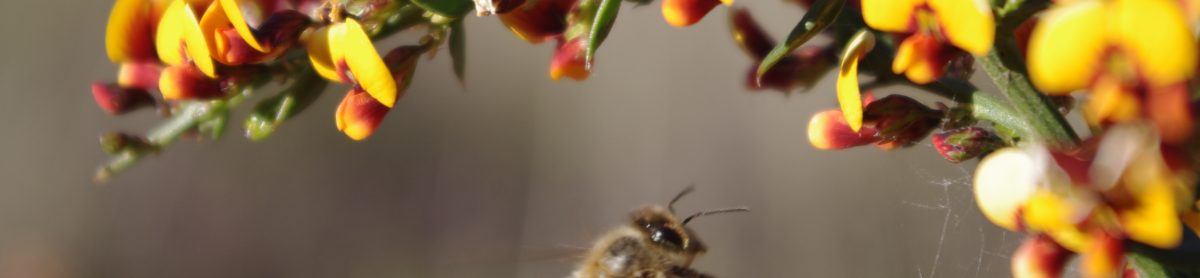
There is also clear evidence of prior occupation by bees. The colder weather seems to driven them away.

And for further reference and contrast, below is a typically inelegant Phascogale nest from another site. It seems our resident Phascogales are comfortable enough at the moment in the ceiling of our home – and who can blame them –  what with the pre-insulated  cavity and reliable slow combustion heating from below?

Thanks to Bryan McMullin for the photos.

Muckleford Gorge

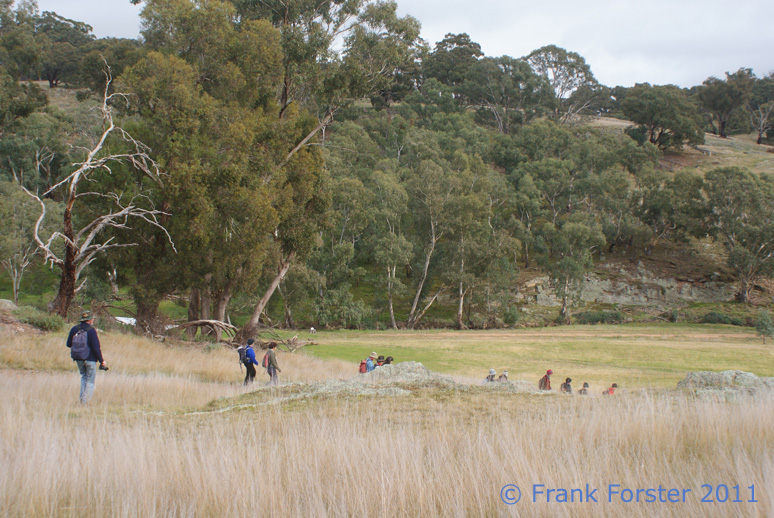
Members and supporters of local Landcare groups had a rare opportunity to visit the Muckleford Gorge on Sunday 15 May.  The visit was scheduled as an activity of the Friends of the Box Ironbark Forests group (FOBIF).  As a first-time visitor to this much-vaunted but somewhat secretive location, I was wondering if the Gorge would live up to expectations.  I am happy to report that the Gorge was even more spectacular and stunning than anticipated, no doubt enhanced by the volume of water still flowing down its midst.

A large group of walkers assembled at the Point View property for a welcome by owner and sheep farmer Ian Garsed.  Unfortunately, due to the vicissitudes of local football, Ian was unable to accompany us on the walk.

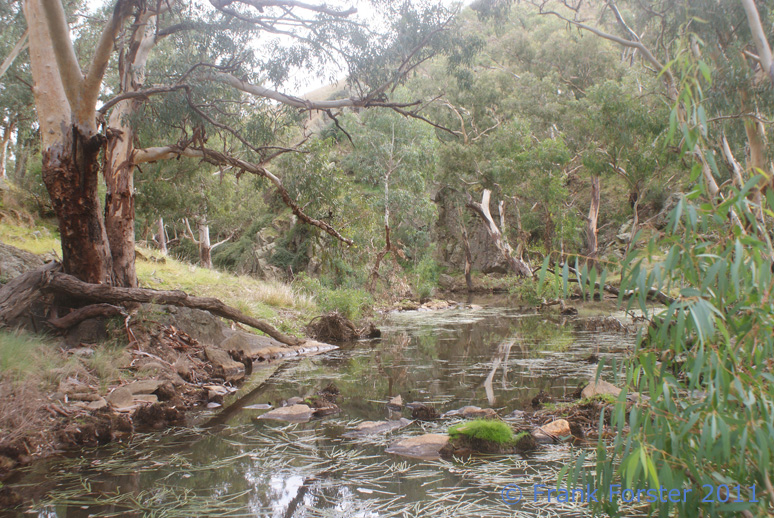
The first section of the walk was along the eastern ridge of the Gorge and then down the track to the river flats and The Palace, a favourite gathering place for the Garsed family.  Down close to the creek the evidence of the January floods was still prominent in the fences, in the trees and along the creek bed.

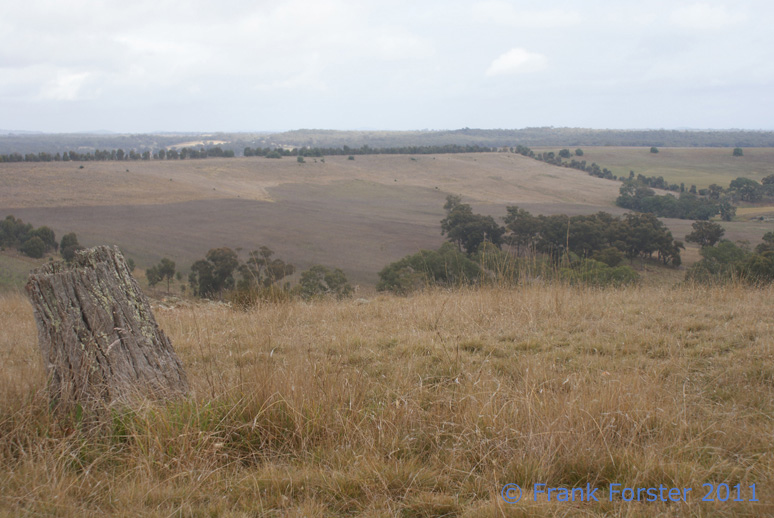
After crossing the creek we climbed to the top of the western ridge, noticing the very different geological structure and vegetation.  From the top of the ridge the volcanic structure of the eastern side of the Gorge was most evident.

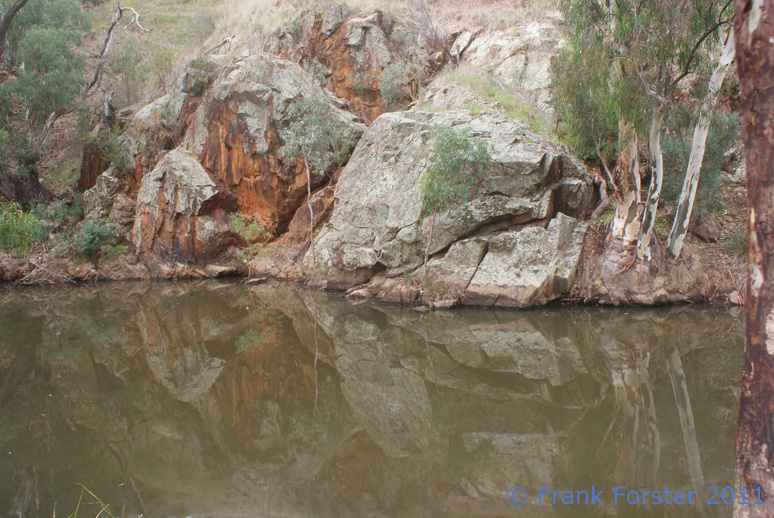
From here the group descended to one of the most scenic sections of the Gorge featuring some impressive rock walls, significant trees and wonderful native grasses.  There was still a steady flow of water through the Gorge but some of the pools afforded lovely reflections.

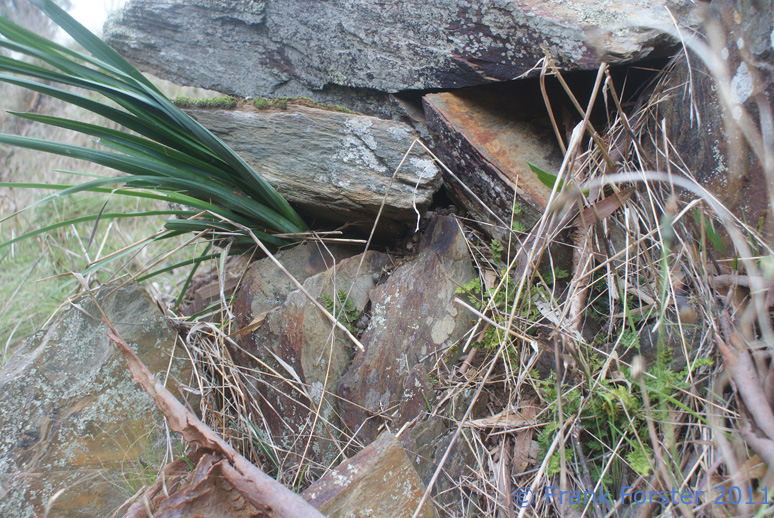
Further along the creek we discovered some interesting specimens of Dianellas along with a number of small ferns emerging from various rock formations.

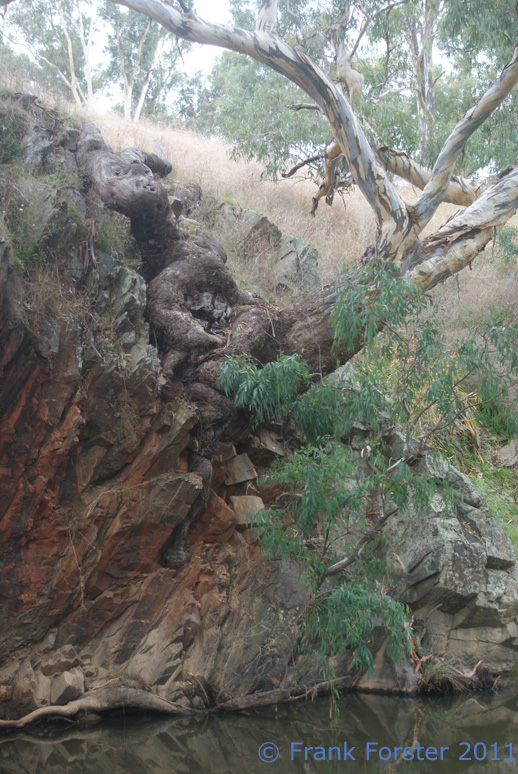
On the eastern bank of the Gorge a number of large eucalypts were impressively intertwined with the surrounding rock formations. enabling them to cling to some precarious positions over the creek.

Climbing back out of the Gorge we passed some fine examples of sedimentary rock laid down in layers and uplifted by earth movements.  These rock formations were home to an all together different range of plant life, principally fungi and mosses.

The group returned to the ford and The Palace for a debrief with Ian Garsed.  A number of interesting aspects of the history and the usage of the Gorge were discussed.  Finally the walkers climbed back up to the eastern plateau and the conclusion of the expedition.

Muckleford Gorge is a very special feature of our local landscape and one with high conservation values.  The Gorge is currently under a Bush Tender conservation agreement between the landowner and DSE.  This arrangement should ensure that the unique aspects of the Gorge will be maintained and enhanced for the foreseeable future.  For this we should all be very grateful.  And if you ever have an opportunity to visit Muckleford Gorge (with the active consent of the landowner, of course) don’t miss it!

Fallen Giants

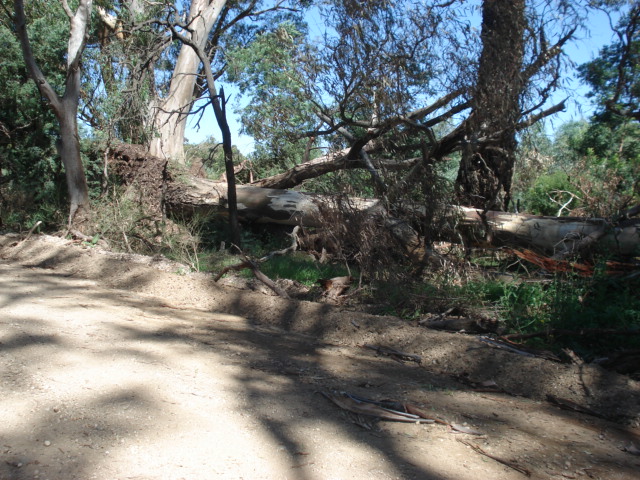
Another one comes down - look out!

Lewis Road has been identified as having significant roadside vegetation and is lined with remnant Yellow Box, Grey Box and River Red Gum.  The recent flood events have seen a significant number of very large trees falling and in many instances taking with them large branches of adjacent trees.

Trees have been failing in the lower lying areas near Chinaman Creek where we find most of the Yellow Box and Red Gums.  This phenomenon is rarely seen out in the open paddocks.  Why is this so?

As we know the rainfall has been extraordinarily high in the past 6 months and soils have reached saturation point.  Wet soils have a lowered shear strength (holding ability).  Considerable loads are applied onto the tree root system from the mass of the tree coupled with the additional weight of water in the canopy.  Add some wind gusts and the tree’s stability can be compromised.

Roadside trees have usually developed in groups where adjacent trees buffer wind forces.  The tree roots do not need to develop as broadly as trees growing in the open where they are more exposed to constant environmental impacts.  Healthy trees are marvellous biomechanical structures that can self-optimise when injured or stressed.

We humans have our inputs too.  Roadside vegetation is subject to repeated patterns of disturbance from activities such as road grading and drainage works.  As trees age they are less able to tolerate change in their environment and have reduced energy reserves available for adaptive growth.

Plenty of large woody habitat in the roadside